The Ombudsman publishes guidelines and standards to help interpret and apply the Public Interest Disclosures Act 2002 (Tas).
Serious or significant improper conduct
One of the purposes of the Act is to encourage and facilitate disclosures of improper conduct by public officers and public bodies.
Improper conduct has a specific meaning under the Act. According to section 3 of the Act, improper conduct means:
- illegal or unlawful activity
- corrupt conduct (a definition of corrupt conduct is also found in section 3)
- maladministration
- professional misconduct
- wasting public resources
- endangering public health or safety
- conduct that is a danger to the environment
- misconduct, including breaches of any codes of conduct that apply
- detrimental action against a person who makes a public interest disclosure under the Act.
The improper conduct must also be ‘serious or significant’.
Guideline One
Guideline One - Serious or significant improper conduct (PDF, 653.0 KB), issued by the Ombudsman, helps to assess whether improper conduct is serious or significant.
Procedures to be followed by public bodies
Public bodies must establish procedures for dealing with disclosures about improper conduct. These procedures must comply with the Ombudsman’s guidelines and standards. The Ombudsman must review and approve the procedures of large public bodies every three years.
Guideline Two
See the amended Guideline Two – Procedures for Public Bodies (PDF, 937.1 KB) for more information on procedures to be followed by public bodies.
The Ombudsman’s model procedures for public bodies are in Attachment A of Guideline Two. A Microsoft Word version of the model procedures (DOCX, 841.4 KB) is available for public bodies to edit to suit their requirements. The forms at Attachments 1 to 3 are also provided as locked forms (DOCX, 57.0 KB) for ease of use if that is preferred.
Flowchart - process for public bodies
A flowchart (PDF, 430.8 KB) sets out the process under the Act for public bodies and is included in the model procedures.
Disclosure to a public body flow chart
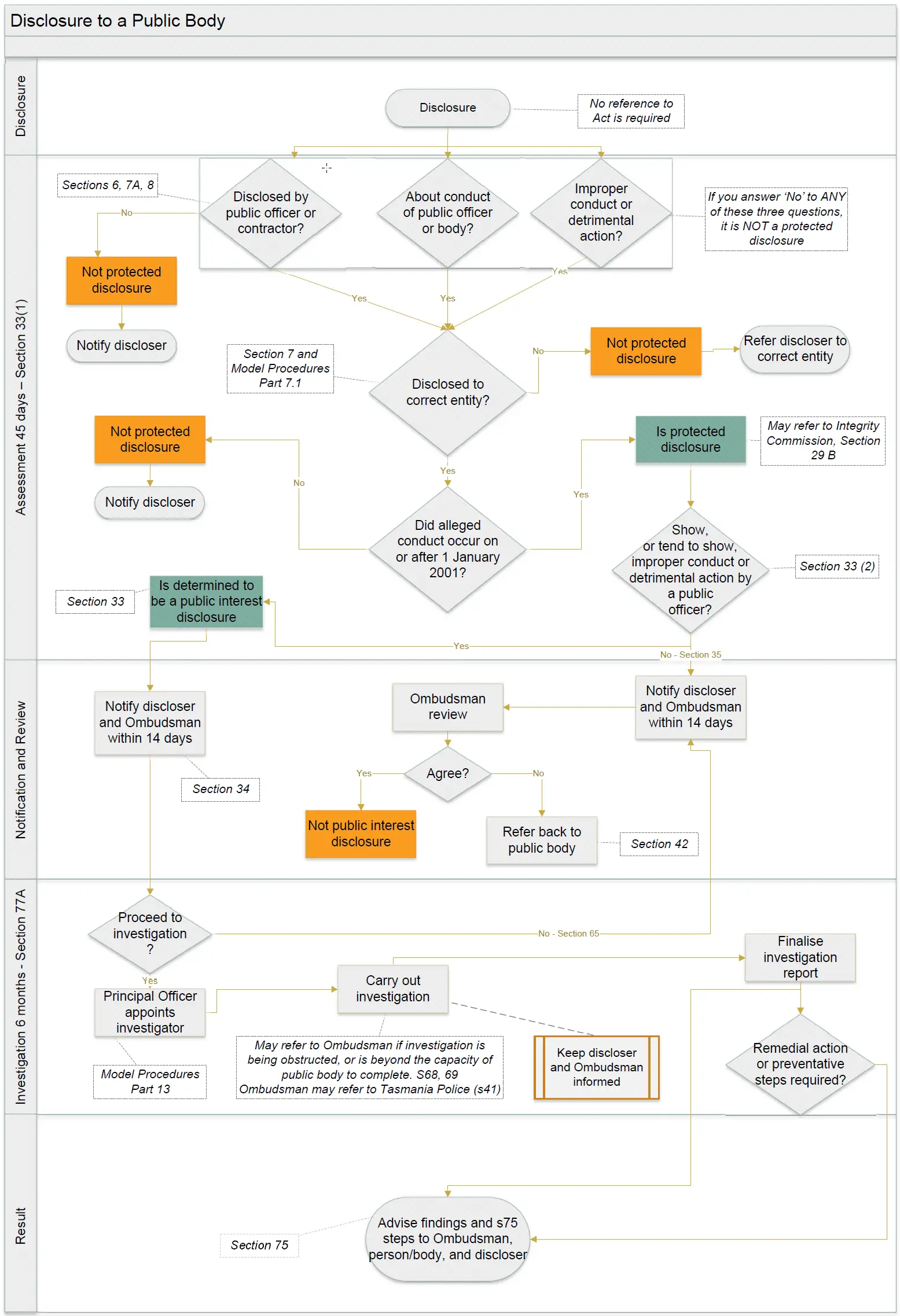
Disclosure to a public body text version
Disclosure received (No reference to Act is required)
Assessment stage – must be completed within 45 days – Section 33(1)
Is the disclosure
- Disclosed by public officer or contractor (Sections 6, 7A 8)?
- About conduct of public officer or body?
- Improper conduct or detrimental action?
If you answer ‘No’ to ANY of these three questions, it is NOT a protected disclosure, notify discloser.
If ‘Yes’ to ALL of these three questions, was the disclosure
- Disclosed to correct entity (Section 7 and Model Procedures Part 7.1)?
if no
- Not protected disclosure, refer discloser to correct entity.
if yes
- Did alleged conduct occur on or after 1 January 2001?
if no
- Not protected disclosure, Notify discloser.
if yes
The disclosure is a protected disclosure (May refer to Integrity Commission, Section 29).
Does the disclosure show, or tend to show, improper conduct or detrimental action by a public officer? (section 33 (2))
Notification and Review stage
- if no
- Notify discloser and Ombudsman within 14 days (section 34)
- ombudsman reviews determination
- if agrees, the disclosure is not a public interest disclosure.
- if Ombudsman does not agree, disclosure is referred back to public body (section 42).
- ombudsman reviews determination
- Notify discloser and Ombudsman within 14 days (section 34)
- if yes
- disclosure is determined to be a public interest disclosure (Section 33). Notify discloser and Ombudsman within 14 days (section 34).
Investigation stage – to be completed within 6 months – Section 77A
- proceed to investigation?
- if no (section 65)
- Notify discloser and Ombudsman within 14 days.
- ombudsman reviews decision
- if Ombudsman agrees, not a public interest disclosure.
- if Ombudsman does not agree, disclosure is referred back to public body.
- ombudsman reviews decision
- Notify discloser and Ombudsman within 14 days.
- if yes
- Principal Officer appoints investigator (Model Procedures Part 13)
- Carry out investigation
- May refer matter to Ombudsman if investigation is being obstructed or is beyond the capacity of public body to complete – s68, s69. Ombudsman may refer to Tasmania Police – s41.
- Keep discloser and Ombudsman informed.
- if no (section 65)
Result stage
- Finalise investigation report.
- Remedial action or preventative steps required?
- advise findings and s75 steps to Ombudsman, person/body, and discloser.